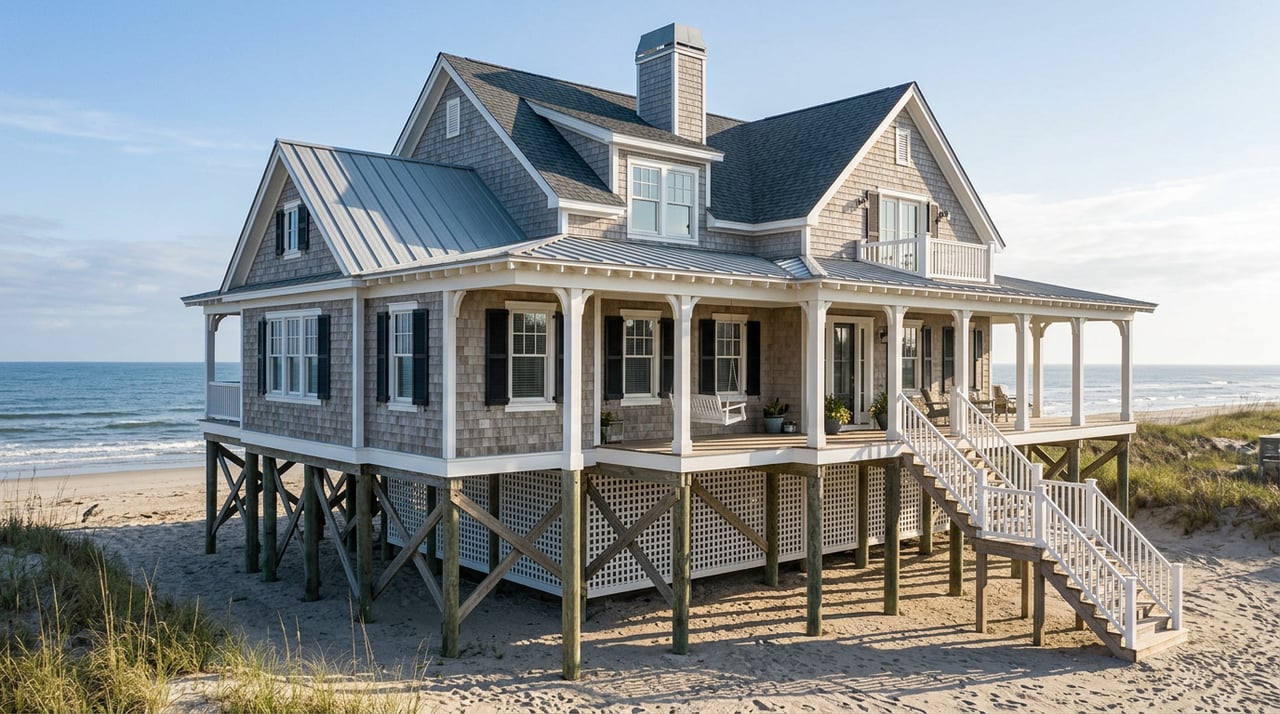
Mantoloking is small enough that you can walk its full length in under an hour. The borough's own hazard page puts the numbers plainly: about 2.2 miles of oceanfront, about 3.0 miles of bay shoreline, the entire town sitting on a barrier strip between the Atlantic and Barnegat Bay. There's no downtown to speak of. What there is instead is a summer that runs on three separate calendars, and almost nobody who lives here checks all three at once.
The first calendar belongs to the Borough itself, and it reads like a municipal to-do list. The second belongs to the Mantoloking Yacht Club, a private institution older than the automobile, and it isn't posted anywhere the public can see. The third is borrowed wholesale from Bay Head next door, because a town this size doesn't have the population to run its own Fourth of July from scratch. Layered under all three is a fourth thing that isn't a calendar at all: a federal beach project that can close a stretch of oceanfront for weeks regardless of what any of the other three say.
Knowing which calendar governs which part of your summer is the difference between a resident who gets caught off guard in July and one who doesn't.
The Borough's Clock
The most visible calendar is also the least social. It's made of deadlines: sewer bills due April 20, tax quarters due the first of the month, and a seasonal rule that actually shapes what a Mantoloking morning sounds like. The borough bans gas-powered leaf blowers from June 15 through Labor Day, both for residents and for the landscaping crews working their properties. As of this week that ban is still in force. It lifts with Labor Day, which means the quiet mornings some residents have gotten used to since mid-June are about to end.
The same civic calendar governs trash. Bulk pickup happens on the first Thursday of every odd-numbered month, January, March, May, July, September, November, and items have to sit at the curb the night before, separate from regular household trash. It also governs beach protection in a way that's easy to miss. The borough's own dune ordinance bars mechanical dune replenishment, meaning bulldozing sand on the beach, from April 1 through September 1 each year without an emergency declaration. That window just closed on September 1. Practically, that means the several-month blackout on bulldozer work at the dune line just ended, and any grading work the borough or a property owner has been waiting to do can now resume.
None of this is exciting reading, which is exactly why it's easy to ignore until the day a landscaper shows up with the wrong equipment or a bulk item sits at the curb three weeks too early.
The Yacht Club's Clock
The second calendar is the one you won't find on any town website, because it isn't public. The Mantoloking Yacht Club has operated on Barnegat Bay since 1907, a private, family-oriented sailing club known for its junior sailing program and its long tradition of one-design racing. The club runs seasonally from May to October, and inside that window its own calendar fills up fast: weekly family Sandpiper sailing events, Friday Night Dinners, Dinner Dances, Governors' Cocktail Parties, and its own Fourth of July Parade, separate from the public one. It's a member of the Barnegat Bay Yacht Racing Association, a regional group of fourteen sailing clubs that coordinates racing and social events across the bay each summer.
If you're not a member and don't know one, this entire layer of the summer is invisible. You'll see the sails on the bay on a Wednesday evening and have no idea there's a Sandpiper race happening, or that half the boats tied up at the club dock belong to a social calendar running in parallel to the one you're following.
The Borrowed Calendar
The third calendar is the one Mantoloking leans on because it has to. A town this size can't sustain its own Independence Day production, so it splices into Bay Head's. The bike parade, the porch decorating contest judged at Centennial Park, the Art in the Park festival, all of that belongs to Bay Head. Mantoloking keeps exactly one piece of July Fourth entirely its own: the Robert J. Morris Flag Raising on Bay Avenue at 12:45 p.m., timed to land right after the shared parade wraps.
The same borrowing shows up later in the summer. Glimmer of Hope, the lantern-floating gathering at Twilight Lake where attendees purchase a paper lantern for ten dollars at Manasquan Bank or The Grenville and set it adrift with a personal reflection, is technically a Bay Head event. Mantoloking residents show up anyway, because the alternative is no lantern night at all.
Even retail news gets borrowed. When there was an actual piece of commercial news to report this summer, it wasn't a business opening on Bay Avenue. It was a Food Emporium moving into the former Stop and Shop on Richmond Avenue in Point Pleasant Beach, a few miles north. That's where the grocery run happens. That's not a complaint about Mantoloking. It's just an honest description of how a town without a commercial strip actually functions day to day.
The Calendar Nobody Controls
The fourth layer isn't really a calendar. It's a federal construction schedule, and it can override everything above it without warning.
Mantoloking sits inside the Army Corps of Engineers' Manasquan Inlet to Barnegat Inlet Storm Damage Reduction Project, a beachfill and dune program that runs 13.7 miles of oceanfront across nine towns, from Point Pleasant Beach down through Berkeley Township, and moves an estimated 10.7 million cubic yards of sand along the way. The most recent documented round in Mantoloking, the sixteenth beach replenishment campaign on record, started in late August 2025 behind 1229 Ocean Avenue. The beach closed between Herbert and Downer streets while the work moved through, and lifeguards normally stationed at Downer were relocated to Princeton for the duration.
That's the part worth sitting with. The borough's own dune ordinance protects the beach from local bulldozing between April and September, precisely to preserve swim season. But that local rule doesn't touch the federal pump-and-fill project, which operates on its own timeline and can close a specific stretch of oceanfront in the middle of August if that's when the contractor's equipment is available. The rule that looks like it protects your summer beach access only covers one kind of construction. It doesn't cover the other.
The Hazard With No Calendar At All
One more thing worth tracking has no schedule whatsoever: clinging jellyfish. They're small, about the size of a quarter, and their sting has sent adults to the emergency room. They've been confirmed in New Jersey waters since 2016, and locally they turn up at Wardells Neck in Barnegat Bay, just north of the Mantoloking Bridge, and in the Metedeconk River. The species tends to bloom from mid-May into early August, clinging to eelgrass and submerged vegetation in shallow, calm water rather than drifting through the surf.
The reassuring part, and it's worth saying plainly, is that they're a bay and back-bay species. They aren't found on ocean beaches or in open surf. The risk sits specifically with bayside activity: crabbing off the bulkhead, paddleboarding near grass beds, fishing from the Mantoloking Bridge pier. State officials monitoring the population have described it as largely stable since 2016, which means this isn't a new or worsening problem so much as a known one that resets every spring and fades by late summer.
Reading All Three at Once
None of these calendars was built to talk to the others. The borough tracks deadlines and ordinances. The yacht club tracks its own members. Bay Head tracks its own parade. The Army Corps tracks its own contract schedule. A resident who wants the full picture has to check all four sources, and most people only find out about the mismatch when something they expected to happen didn't, or something they didn't expect closed a street they use every day.
If there's one thing this pattern says about the town, it's that Mantoloking's identity isn't self-contained. It's assembled, borrowed in places, private in others, and occasionally overridden by an agency none of the calendars answer to. That's not a flaw. It's just how a barrier-island town of this size actually runs, and knowing it is worth more than knowing the parade route.
If you're weighing a move to Mantoloking, Bay Head, or anywhere else along this stretch of the Ocean and Lower Monmouth County coast and want a read on how a specific block or building actually behaves through the seasons, Brenda Weld has spent two decades tracking these details street by street. Let's Connect.